
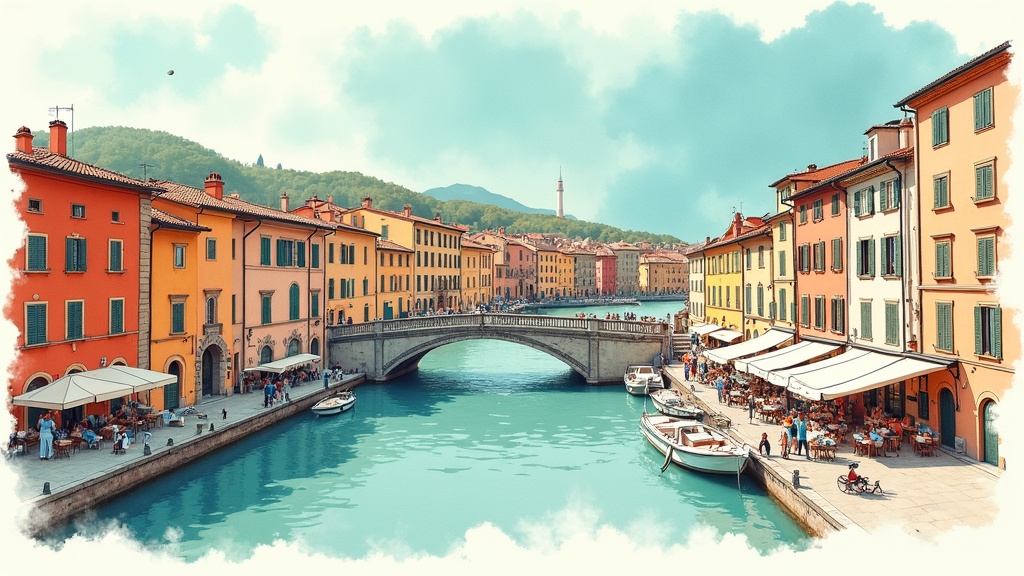
Trieste, Italy sits at the very tip of a limestone plateau where the Adriatic meets Slovenia, and in winter it becomes something genuinely difficult to explain to people who haven't stood there with their coat pulling sideways in the bora wind. It's the reason to go. Not the ruins, not the sunsets, not some checklist item. The reason is that this city exists in a kind of permanent identity argument with itself, and winter is when that argument gets loudest and most honest.
The City That Borrowed From Everywhere and Kept the Change
Here's the short version of why Trieste is different. For centuries it was the only major seaport of the Habsburg Empire, which meant Vienna poured money, architecture, and people into it. Austro-Hungarian merchants, Greek Orthodox traders, Slovenian workers, Jewish intellectuals, and Irish writers all passed through or stayed. James Joyce wrote most of Dubliners here. Rainer Maria Rilke wrote the Duino Elegies in a castle on the coast just outside town. The city absorbed all of it and never quite became entirely Italian, even after 1954 when it finally, formally, joined Italy for good.
What that produces is a streetscape that looks like a Habsburg imperial city that someone dropped on the Mediterranean. The Piazza Unità d'Italia opens directly onto the sea, which no other main square in Europe does. The coffee culture here predates Italy's by decades. Locals order a capo in b (a macchiato in a glass) using vocabulary that exists nowhere else in the country. When you understand that, you understand why asking why visit Trieste Italy in winter is actually the right question, because summer blurs the edges. The tourists arrive, the terraces fill up, and the city performs. In winter, it stops performing.
The bora helps with that. This is a katabatic wind that comes screaming down from the Karst plateau at speeds that can exceed 100 kilometers per hour. The city has iron handrails bolted to walls along certain streets so people can hold on. In winter it arrives without apology several times a month, and it has the peculiar effect of making Trieste feel inhabited rather than staged. People walk fast, duck into cafes, talk loudly. The city belongs to them again.
What You Actually Do in Winter Here
You drink coffee, first. Not as a tourist activity, as a structural requirement of the day. Caffè degli Specchi on the Piazza Unità has been there since 1839. Caffè San Marco in the university quarter has dark wood paneling and newspaper rods and the atmosphere of a place where someone is always about to write a novel. You don't need to arrive with an itinerary. You need to arrive with time.
The Museo Revoltella is a palazzo turned contemporary art museum, and it's genuinely worth two or three hours on a cold afternoon. The Castello di San Giusto sits up on the hill above the Roman theater ruins, and the walk up is short enough to do between a morning coffee and lunch without feeling like you've earned anything particularly. The old ghetto quarter, the Borgo Teresiano with its canal, the Serbian Orthodox church of San Spiridione with its gold interior — these aren't crowded in winter. You walk in, look at them, leave. That's it.
The border with Slovenia is about thirty minutes away by car. Lipica, where the Lipizzaner horses originally came from, is just across it. The Karst region on both sides has wine caves and prosciutto villages where you eat standing up at wooden counters. In winter the roads are quiet, the cellars are warm, and the people running them have time to talk. You don't need a tour. You need a rental car and a rough sense of direction.
When to Go and How to Get There
Late November through February is the honest window. You'll get the bora, you'll get the cold, you'll get the city at its least decorated and most real. Hotel prices drop considerably compared to summer. The restaurants that stay open are the ones locals use, not the ones that exist for foot traffic.
Trieste has its own airport, Trieste Airport (TRS), with connections to Rome, London, and several other European cities, though the schedule is thinner in winter so check early. Venice Marco Polo is about two hours by car or a train-and-bus combination, and trains from Venice to Trieste run regularly, which makes it straightforward to pair the two if you want contrast. The train journey along the coast from Venice is one of the better ones in northern Italy, sea on one side, limestone on the other.
Driving from Ljubljana takes under two hours and the road is good. If you're coming from Vienna, the train through Graz is a genuinely scenic option and lands you directly in Trieste Centrale, which is itself a beautiful Austro-Hungarian station that makes the arrival feel correct.
For accommodation, the city center is compact enough that almost everything walkable matters. A room near the Piazza Unità or the Borgo Teresiano puts you within ten minutes of most things. Boutique options exist in the older palazzi and they tend to be more interesting than the chain options near the station.
Book It Before You Talk Yourself Out of It
Trieste is the kind of city people say they'll get to eventually. Eventually usually means never. Winter is actually the argument for going now, not someday, because the version of Trieste that exists from December through February is the one that earns all the literary references and the cultural mythology. The wind is real. The coffee is serious. The border is close enough that you're never entirely sure which tradition you're inside.
Start putting your trip together now at places-to-go-travel.com, where you can compare flights, find accommodation options, and book the pieces of the trip without paying more than you should.
The bora doesn't wait for your schedule to clear up. Go in winter. That's the point.